Kräuterlei am Wörthersee Celebrates Austria’s New Certified Forest Therapy Trail
Some forests seem to ask very little of us. 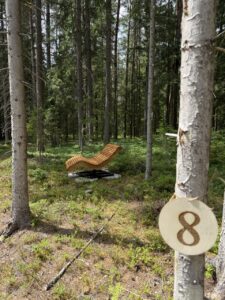
They do not demand attention. They do not compete with the noise of modern life. They simply wait – offering shade, birdsong, the scent of pine needles warming in the sun, and the quiet invitation to slow down.
In the rolling landscape of southern Austria, near the turquoise waters of Lake Wörthersee and the borders of Slovenia and Italy, one such forest has been patiently nurturing relationships for generations.
Today, that forest is beginning a new chapter.
The Forest Retreat Trail at Kräuterlei am Wörthersee has been recognized as a Certified Forest Therapy Trail by the Association of Nature and Forest Therapy (ANFT), creating a place where visitors can experience the restorative power of nature while deepening their connection to the land, themselves, and the more-than-human world.
A Forest Stewarded Across Generations
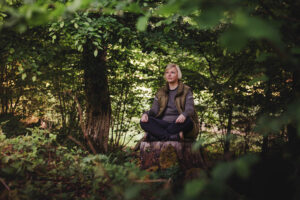 For landowner Anita Arneitz, the trail is much more than a project. It is part of a relationship that stretches back nearly a century and a half.
“My family and I have been closely connected to this land and forest for generations – around 150 years,” she says.
Today, Kräuterlei is a thriving herb farm surrounded by meadows, forests, and peatland, but Anita’s connection to the land was shaped long before forest therapy entered the picture.
“The place has always been a source of strength for us,” she explains. “Nature is the most precious thing we have.”
Her grandparents spent their days in these woods. Her father often says, “We know every tree personally.”
That sense of intimacy with place became the inspiration for the trail.
Anita envisioned a space where others could experience what her family has known for generations – that slowing down in nature cultivates mindfulness, respect, gratitude, and care for the living world.
When a Forest Reveals Its Purpose
The idea for certification emerged during a conversation between Anita and Barbara Wiegele, ANFT Certified Forest Therapy Guide and Trails Consultant.
Barbara had spent years leading people into meaningful encounters with nature and had developed what she calls a capacity for “reading places.”
At the end of an interview with Anita, she recognized something special.
“This place would be perfectly suitable for forest therapy,” Barbara recalls.
The response was immediate.
Without ever having experienced a guided ANFT forest therapy walk, Anita embraced the possibility. What followed was a remarkable collaboration that continues to grow beyond anyone’s original expectations.
Funding was secured. Plans took shape. Anita began training to become an ANFT Forest Therapy Guide herself. New partnerships emerged.
“It seemed as though everything fell into place,” Barbara says. “The forest supported all our steps.”
Letting the Forest Lead
 One of the most distinctive aspects of the project is what was not done.
Some trails are built through extensive development. Here, the goal was the opposite.
Anita’s vision was to interfere as little as possible with the forest.
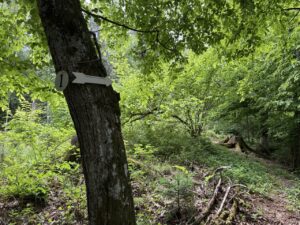
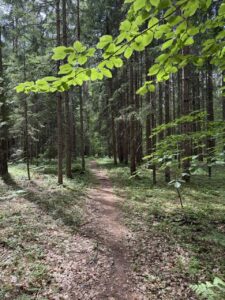
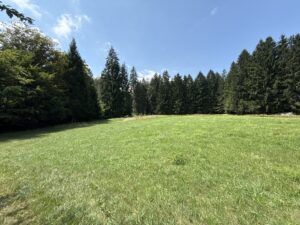
The trail follows existing paths through a landscape of meadows, mixed forest, and regenerating woodland. Simple wooden markers guide visitors along the route. A few carefully placed benches provide places to rest and reflect. An audio guide and small brochure offer invitations for self-guided experiences.
Beyond some vegetation clearing and minor safety improvements, the forest remains largely untouched.
The result feels like a conversation with a living landscape.
Meeting the Residents
The trail winds through approximately 900 meters of forest and meadow, revealing the extraordinary biodiversity that Anita is so passionate about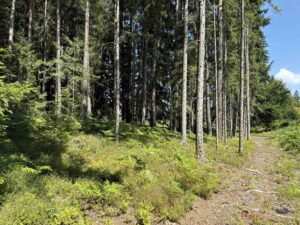 protecting.
Visitors may encounter deer, foxes, and hares moving through the landscape. Woodpeckers drum in the trees while hawks and owls patrol overhead. Wood ants carry out their daily work along the forest floor.
At the edge of the forest, two pygmy goats contribute their own unique form of stewardship as dedicated landscapers.
The plant community is equally rich.
Spruce, pine, oak, and beech create the forest canopy. Elder, hawthorn, blackthorn, and wild cherry provide food and habitat. Mosses, lichens, woodland herbs, mushrooms, bilberries, raspberries, and wild strawberries weave together a complex living tapestry.
Each season offers a different experience. Each visit reveals something new.
More Than a Trail
 What began as a forest therapy project has evolved into something larger.
The trail has become a meeting point where health, conservation, education, sustainable tourism, and community wellbeing intersect.
The local response has been overwhelmingly positive, inspiring a growing network of collaborations and future initiatives.
Plans are already underway for psychological research examining the health benefits of nature connection. Educational programs focused on biodiversity and conservation are being developed. An online conference exploring wellbeing in nature is in the works, alongside artistic and cultural projects that deepen engagement with the landscape.
Guided forest therapy walks will complement existing workshops in creative writing, nature journaling, and herbal traditions.
Nearby, a sit spot overlooking a peatland will offer yet another opportunity for quiet connection.
“The forest has connected many different areas,” Anita says. “Sustainable tourism, health promotion, conservation, agriculture, and forestry.”
What began as a trail is becoming a movement.
A Place for the Future
For Barbara, one of the most important lessons of the project has been the value of listening.
“The vision of the landowner is key,” she says. “I learned so much from Anita’s stories and her love for the land.”
She also learned from the forest itself.
Its animals. Its plants. Its weather. Its changing seasons.
Together, those voices helped shape the invitations that now guide visitors through the experience.
Looking ahead, both Anita and Barbara see the Forest Retreat Trail as more than a destination. They envision it as a model – one that inspires similar projects throughout Austria and beyond.
A place where people can discover that wellbeing and conservation are not separate goals.
A place where protecting biodiversity begins with falling in love with it.
A place where a family relationship with the land, cultivated over 150 years, can now be shared with the wider world.
And perhaps most importantly, a place where the forest itself remains the true guide.