Singapore Botanic Gardens Unveils a ANFT Certified Forest Therapy Trail
In the heart of a city defined by motion, there is a place where time softens.
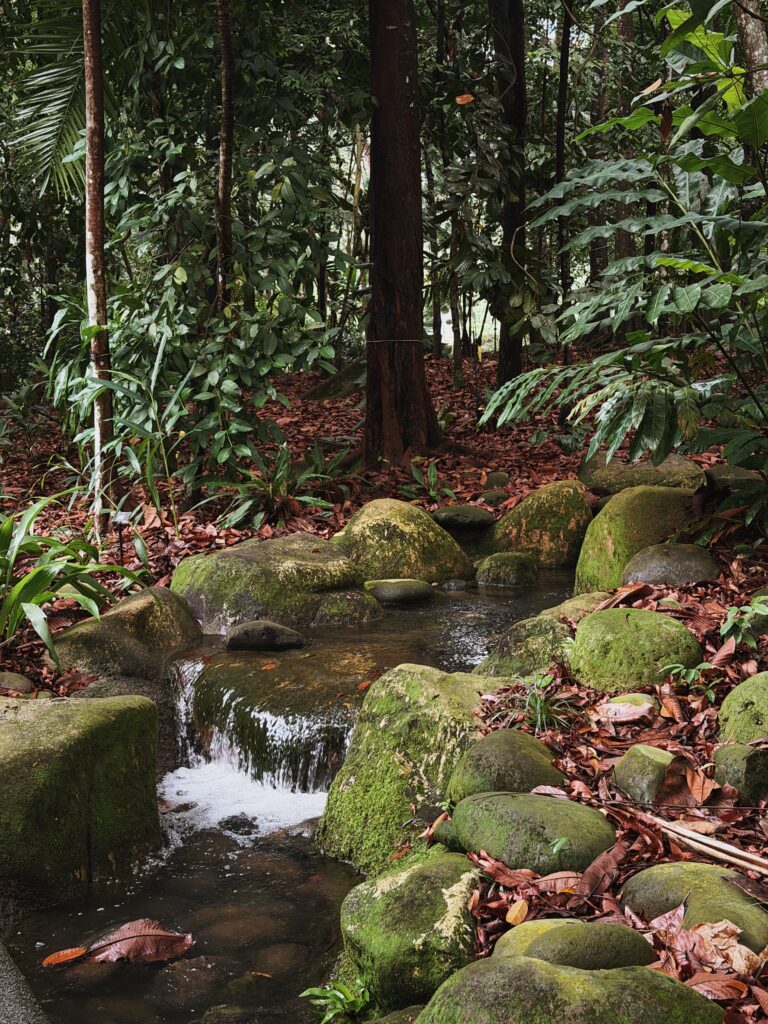
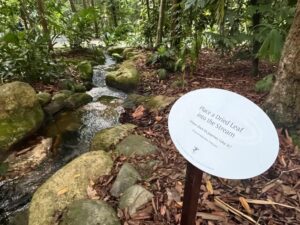
Light filters through towering tropical canopies. A stream winds quietly through the landscape. The air hums with cicadas, and leaves shift gently overhead.
This is the Saraca Trail within the Singapore Botanic Gardens – and now, it offers something more than a walk.
It offers an invitation.
Recognized as a Certified Forest Therapy Trail by the Association of Nature and Forest Therapy (ANFT), the Saraca Trail has been thoughtfully shaped to encourage visitors to slow down, notice, and reconnect with the living world around them. For the Gardens, this moment reflects a natural evolution of a space that has long held deep ecological, cultural, and social meaning.
A Vision Rooted in Connection
The inspiration for the trail grew from a simple but profound idea: connection leads to care.
“The forest therapy trail was inspired by a desire to make these experiences more accessible to a wider community,” shares the Gardens team. “Cultivating a sense of connection to the land is a crucial first step toward fostering conservation.”
As Singapore’s first and only UNESCO World Heritage Site, the Singapore Botanic Gardens has always balanced beauty with purpose – offering not just a place to visit, but a place to learn, reflect, and belong.
The Saraca Trail builds on that legacy, inviting visitors into a deeper, more relational experience with the landscape.
A Trail Already Alive with Possibility
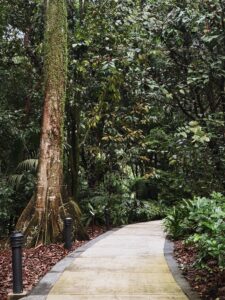 One of the most surprising aspects of the certification process was how naturally the trail embodied the qualities of a forest therapy space.
“One of the most surprising aspects,” the team reflects, “was how it deepened our appreciation for how gentle, open, and self-directed forest therapy can be. We also found the collaborative process especially meaningful, working with like-minded colleagues and receiving strong support from management throughout the journey.”
The path itself – pedestrian-only, accessible, and gently winding – moves alongside the Saraca Stream, framed by lush tropical vegetation and layered canopies. Carefully maintained and supported by attentive stewardship, it offers a rare combination of accessibility and immersion.
“Cultivating a sense of connection to the land is a crucial first step toward fostering conservation.”
Bridging Science, Practice, and Experience
For Angelia Sia, Principal Researcher of S&T Research and Grants at the Centre for Science of Urban Nature, National Parks Board, and an ANFT Certified Forest Therapy Guide and Consultant, the journey to this project began with a question: how can research come alive in real spaces?
“As a researcher, I’ve spent years studying how people interact with nature,” Angelia shares. “The evidence consistently shows that spending time in natural settings supports wellbeing – especially when people feel a stronger sense of connection to nature.”
But research alone wasn’t enough.
“I wanted to go beyond the data and experience these effects firsthand”
“Through training as a forest therapy guide, that understanding became live
d – felt, practiced, and internalized – sparking a vision for integrating such experiences into Singapore’s green spaces in a meaningful and accessible way. This journey deepened my appreciation of nature’s restorative power in a personal and embodied way, and prompted me to explore how these experiences might be extended to more people – for instance, through certified trails with thoughtfully designed invitation signages that gently encourage immersive, effortless engagement with nature.”- Angelia Sia
Walking the Saraca Trail 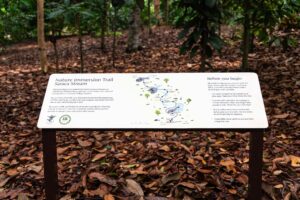
To walk the trail is to move through layers – of sound, light, and sensation.
The path, embossed with leaf patterns, leads visitors through shifting environme
nts. Dense greenery gives way to glimpses of sky. Sunlight flickers through the canopy. The steady pr
esence of water offers a quiet anchor.
Here, participants may encounter drongos calling from above, cicadas humming in the heat, or a monitor lizard slipping silently through the undergrowth. Native plants flourish alongside fruiting species, reflecting the Gardens’ remarkable biodiversity.
But the true transformation lies not in what is added, but in how the space is experienced.
The Power of Gentle Invitation
While the Saraca Trail already offered a rich sensory landscape, Angelia saw an opportunity to deepen how visitors engage with it.
Angelia developed a series of subtle, thoughtfully placed invitations along the trail.
Each one is carefully attuned to its surroundings – encouraging visitors to pause, notice the movement of breath, observe patterns of light, or listen more closely to the rhythms of the forest.
“This process deepened my appreciation for how small, intentional design interventions can shape the way people experience nature,” Angelia reflects. “It’s not about adding more, but about creating space – for stillness, curiosity, and presence.”
Opening the Experience to All
Located near Tanglin Gate and easily accessible by public transport, the trail was designed with inclusivity in mind.
Guided forest therapy walks often have limited capacity. This self-guided trail offers an alternative – allowing individuals to engage with the experience at their own pace, on their own time.
“The layout of the trail allows individuals to engage with the space at their own pace and return over time” the team notes, “fostering an ongoing relationship with nature.”
In a city where access to nature is both cherished and carefully designed, this approach lowers barriers and expands opportunity.
A Living Future
The Saraca Trail represents the beginning of a broader vision.
The Singapore Botanic Gardens plans to expand with additional ANFT certified trails and develop programs that weave forest therapy together with art, music, and other creative practices – opening new pathways for connection and expression.
For Angelia, the project has been both professionally meaningful and deeply personal, shaped by her shared commitment from complementary roles.
“This process has deepened my appreciation for how small, intentional design interventions can profoundly shape the way people experience nature. I learned that creating opportunities for connection isn’t about adding more features, but about making space for stillness, curiosity, and presence. Working collaboratively with the Gardens and ANFT teams also underscored the value of cross-disciplinary dialogue – blending ecological understanding, design sensitivity, and human wellbeing perspectives to craft experiences that feel both grounded and transformation.”
A Quiet Transformation
On the surface, the Saraca Trail has not changed dramatically.
The trees still stand. The stream still flows. The path still winds as it always has.
And yet, something is different.
Visitors who enter now may find themselves moving more slowly. Listening more closely. Noticing things they might have once passed by.
In a city defined by forward motion, the Saraca Trail offers something quietly radical:
A place to pause.
A place to feel.
A place to remember that nature is not separate from us, but something we are always in relationship with.